

 September 14, 2026
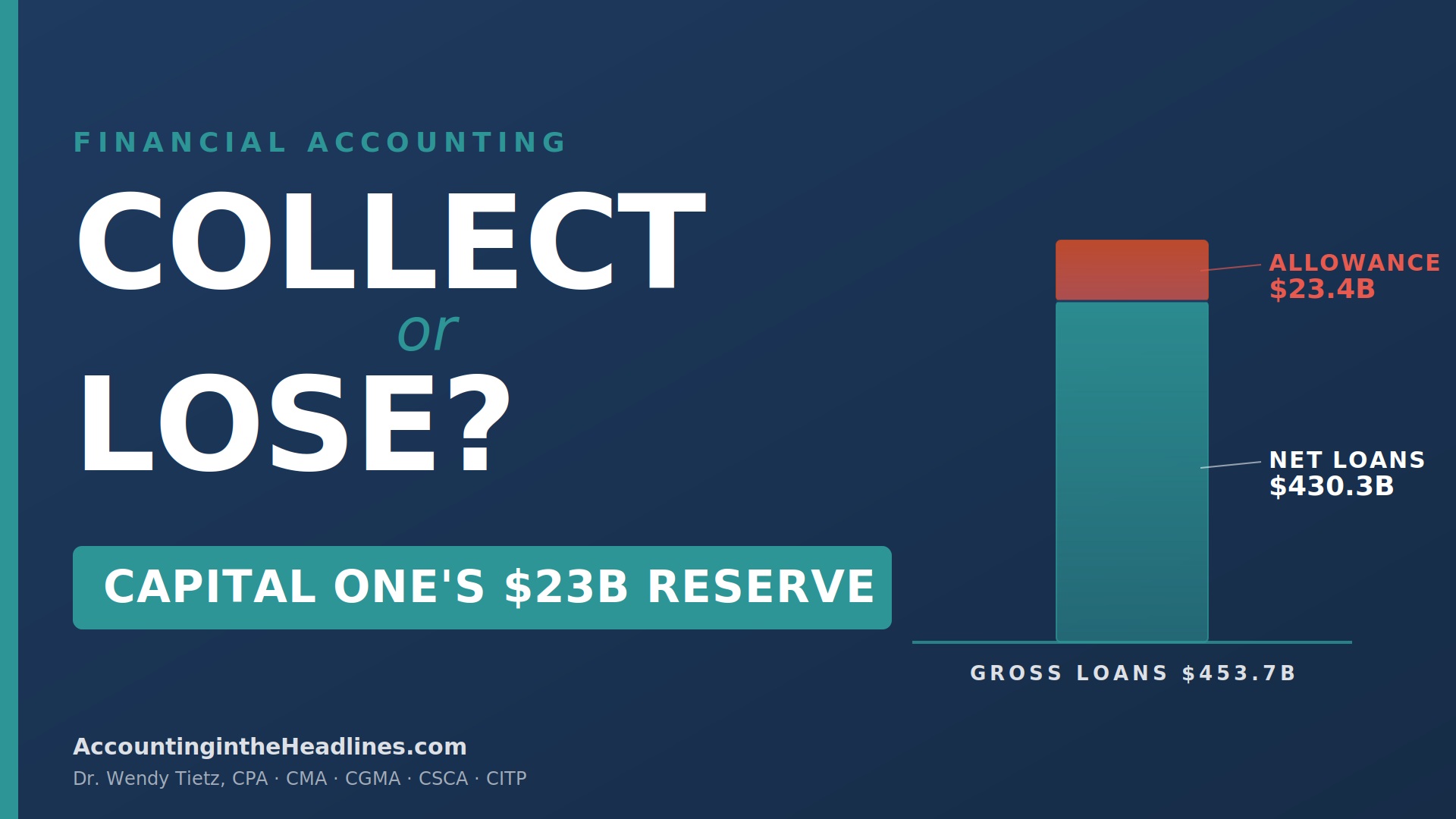
Capital One Financial Corporation (NYSE: COF), one of the largest credit card issuers in the United States, recently reported results that showed profits being squeezed by a jump in loans that customers are not paying back. In the fourth quarter of 2025, the company recorded a $4.1 billion provision for credit losses, an increase of roughly $1.4 billion compared to the previous quarter. As of December 31, 2025, Capital One’s allowance for credit losses stood at $23.4 billion, representing about 5.16% of its total loans held for investment. Management pointed to higher credit card charge-offs, sticky inflation, and continued stress on mass-market consumers as reasons for building the reserve.
Although the headlines focus on the earnings hit, the story is really about a very familiar accounting topic. Banks, credit card companies, and ordinary businesses alike must estimate, in advance, how much of what they are owed will never actually be collected. For Capital One, this means estimating expected losses on billions of dollars of credit card and auto loans. For a typical retailer or manufacturer, it means estimating uncollectible accounts receivable. In both cases, the company records an expense now (bad debt expense, or at a bank, provision for credit losses) and increases a contra-asset account (allowance for bad debts, or allowance for credit losses) that reduces the reported value of the receivable to its net realizable value.
View a quick tutorial video at this [link] and then answer the following questions.
Note to instructors: This post is assignable in Pearson’s MyLab and has questions that are auto-graded.
Discussion Questions
1. Why does Capital One record an expense for loan losses before any specific customer actually stops paying? What accounting principles support recording the expense early rather than waiting until a loan is clearly uncollectible?
2. When Capital One increases its allowance for credit losses by more than a billion dollars in a single quarter, what does that increase signal about management’s expectations for the economy and its customers? Who inside and outside the company pays attention to that signal, and why?
3. The allowance for credit losses is an estimate, not a precise number. What kinds of information would Capital One need to consider to come up with that estimate, and what makes the estimate more difficult in an uncertain economic environment?
4. Some critics argue that giving management discretion over the size of the allowance creates an opportunity to smooth earnings from period to period. How could that happen in practice, and what safeguards exist to limit that kind of earnings management?
5. A small retail store and a large bank like Capital One both use the allowance method for amounts they expect not to collect. In what ways is the concept exactly the same, and in what ways do the scale and complexity differ?


No comments yet... Be the first to leave a reply!