

 May 12, 2026
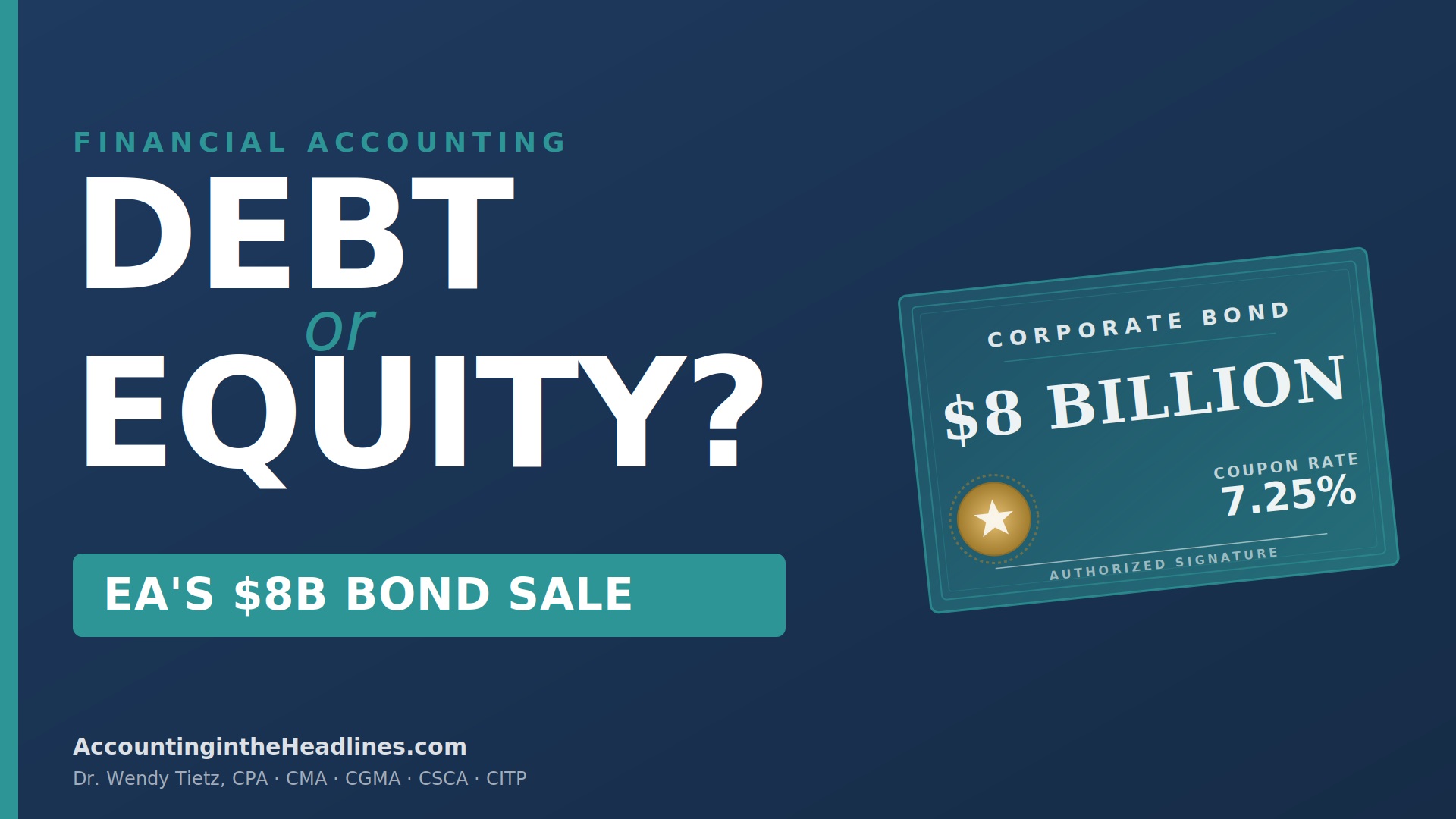
Electronic Arts Inc. (NASDAQ: EA), the maker of Madden NFL, FIFA, and The Sims, is at the center of the largest leveraged buyout in history. A consortium led by Saudi Arabia’s Public Investment Fund, Silver Lake Management, and Affinity Partners is taking EA private in a $55 billion deal expected to close around June 2026. To help fund the transaction, JPMorgan Chase launched an $8 billion junk-bond sale in late March 2026, split into $4.75 billion of secured notes at a 7.25% coupon rate and $2.5 billion of unsecured notes at an 8.75% coupon rate. Once the deal closes, EA’s total debt will jump from roughly $2.2 billion to approximately $20 billion, nearly a tenfold increase.
For a financial accounting student, EA’s bond sale is a textbook example of how bonds affect a company’s balance sheet and income statement. When a company issues bonds, it receives cash and creates a long-term liability. The bonds appear on the balance sheet under Bonds Payable, typically classified as a long-term liability because the principal does not come due for many years. Each period, the company records interest expense on its income statement, calculated as the bonds’ face value multiplied by the coupon rate.
EA’s new bond stack comes in two flavors. The secured notes pay 7.25% interest and are backed by specific collateral, which means investors have a claim on those assets if EA defaults. The unsecured notes pay a higher 8.75% interest rate and are not backed by collateral, so investors take on more risk and demand higher compensation. The 150 basis point spread (or 1.50 percentage points) between the two rates reflects the extra risk.
At those coupon rates, EA will incur roughly $344 million in annual interest expense on the secured notes ($4.75 billion × 7.25%), plus $219 million on the unsecured notes ($2.5 billion × 8.75%). That is more than half a billion dollars per year in interest expense just on the $7.25 billion of junk bonds, before any term loans or other borrowings are layered in. Interest expense reduces net income, which in turn reduces retained earnings and therefore stockholders’ equity.
View a quick tutorial video on accounting for bonds payable at this link and then answer the following questions.
Discussion Questions
- Why might EA’s new owners prefer to finance the buyout with $20 billion of new debt rather than raising that amount entirely from the equity consortium?
- With leverage approximately six times higher after the deal, what kinds of business risks does EA face if a major franchise such as Madden NFL or FIFA underperforms in the years ahead?
- EA’s secured notes pay 7.25% interest and the unsecured notes pay 8.75%. Why would a bond investor accept a lower coupon rate in exchange for having collateral backing the bond?
- Very large leveraged buyouts like EA’s have become more common. What are the arguments for and against taking a well-known public company private through massive new debt financing?
- When EA eventually repays the $4.75 billion of secured bonds at maturity, describe what will happen on EA’s balance sheet on the day of repayment. Which accounts change, and by how much?


No comments yet... Be the first to leave a reply!